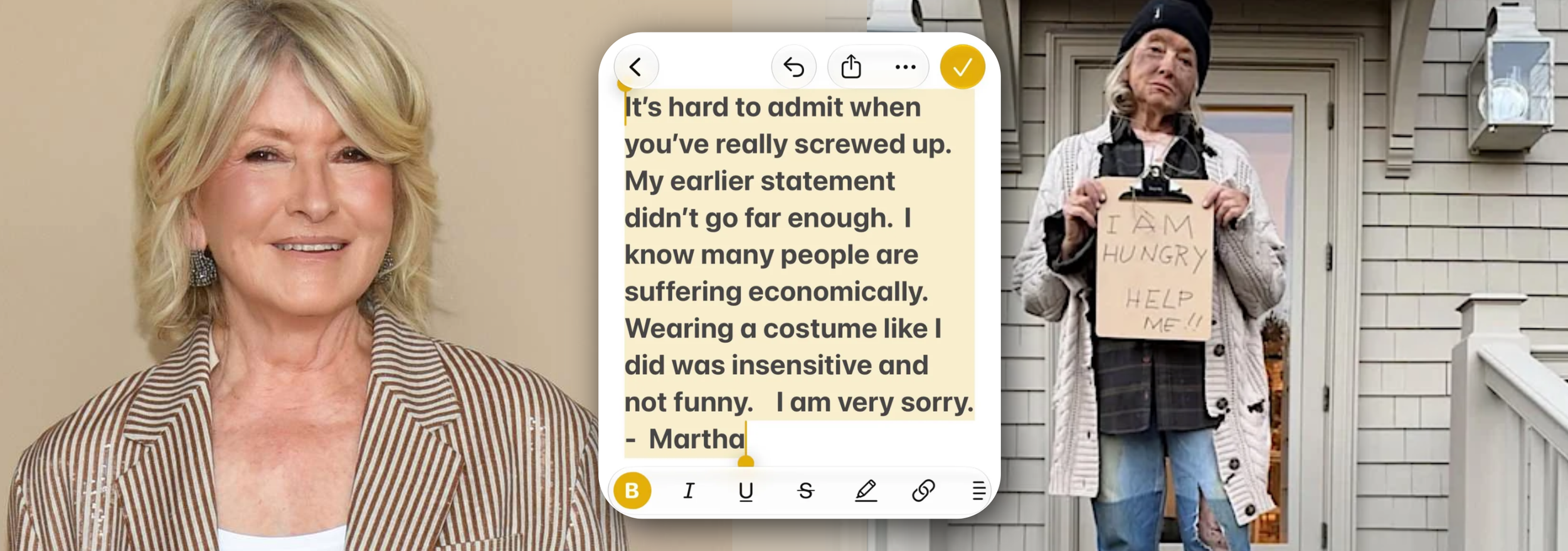
Oh, Martha… Let me start by saying, I love Martha Stewart. I find her to be endlessly fascinating, the queen of reinvention who stays true to herself. Very few brands can survive the way hers has and I have no doubt it will survive this. The Martha Stewart Halloween costume controversy raises bigger questions about social media judgment, approval processes, and what an effective crisis response should accomplish.
In case you haven’t heard, Martha Stewart dressed up as a homeless person, as shared in a now-deleted Instagram post. The post drew backlash and was subsequently removed. According to NBC News, the costume photo was the third image in an Instagram carousel promoting her QVC candles. On November 1, 2026, she issued an initial statement to media outlets, followed later by an apology on Instagram.
So, let’s break down the backlash, Martha Stewart’s Halloween apology, and the crisis communication lessons for brands.
Why Martha Stewart’s Halloween Costume Drew Backlash
It’s insulting when a multimillionaire dresses up as a homeless person. This is bad for Martha because:
She immediately highlighted her wealth and fortunate position in life by dressing up as someone’s daily reality. She could have dressed up as anyone for the night, but she chose a homeless person? Is being homeless the scariest thing a multimillionaire can fathom?
She failed to read the room. There is so much economic uncertainty out there. Hardworking Americans are being laid off by the thousands. Homelessness is a real fear for many, and to her it’s a fun costume.
This is one of those moments where I have to ask myself, how did this happen? I don’t know how Martha’s social media accounts are managed or who reviewed this post. Was there an approval process? If social media, PR, or communications staff were involved, did anyone raise a concern before posting? In moments like this, everyone involved in the communications process needs to be able to flag concerns and know they will be heard.
The post was removed following the backlash, although it’s unclear who made that decision or how quickly. I think, as a first step, this was the right thing to do. Removing the post could limit further amplification, but it couldn’t erase screenshots or stop the conversation. A visible acknowledgment needed to follow so people could find the response and understand what Martha was taking responsibility for.
Where the First Response Fell Short
On November 1, 2026, Martha issued an initial statement to media outlets, including NBC News. It read, in part: “I am distressed that my Halloween costume yesterday, which was intended to bring more awareness to the very serious subject of homelessness, has offended people, which was never my intention.” In the same statement, she said she had spent time and effort supporting charities that combat homelessness and was committed to continuing that work. Raising awareness is a noble goal, but the promotional context makes that explanation harder to reconcile with the post itself. I also think someone with her resources has the means to make a more substantial impact.
To me, the word ‘distressed’ makes Martha sound concerned, but flippant about the whole situation. The statement reads as somewhat disingenuous. Even with the acknowledgment of her charitable work, the emphasis on raising awareness and not intending to offend centers her intentions rather than the impact of the costume. For readers, that can come across as suggesting they misunderstood her, rather than acknowledging why the costume was hurtful.
Why the Second Apology Was Stronger
Then came a second apology, as reported by ABC News: "It's hard to admit when you've really screwed up. My earlier statement didn't go far enough. I know many people are suffering economically. Wearing a costume like I did was insensitive and not funny. I am very sorry.”
This should have been the first statement. Here’s why it was stronger:
Accountability: She admitted she had made a mistake and acknowledged that her first response hadn’t gone far enough.
Acknowledgment of harm: She recognized the economic hardship people are experiencing and explicitly described the costume as insensitive.
Remorse: She directly apologized instead of focusing on what she had intended.
That makes it a better statement. It doesn’t make the recovery complete. The next step is following those words with action.
Social Media Crisis Management Lessons for Brands
I think Martha’s brand will survive this. Here’s what I would recommend next:
Strengthen the social media approval process. Make sure social media and PR are looped in before posts go live and can provide feedback, even if that means a real-time group message. A clear review process can help catch issues before they become public.
Make it safe to speak up. Martha should take a hard look at the team and culture around her. People need to feel comfortable raising concerns, including when the person they’re questioning is the face of the brand.
Follow the apology with meaningful action. She acknowledged that people are suffering economically and pointed to her charitable work. Now would be a good time to explain what that support involves and how she plans to continue it.
For brands and social media teams, effective brand reputation management starts with a process where concerns can be raised before a post goes live and addressed honestly when something goes wrong. A clear apology is a start. The follow-through is what gives people a reason to trust it.